Cyrtan Recovery Hub.
Turning contaminated wood waste from a disposal problem into clean electricity, for a whole cluster of manufacturers.
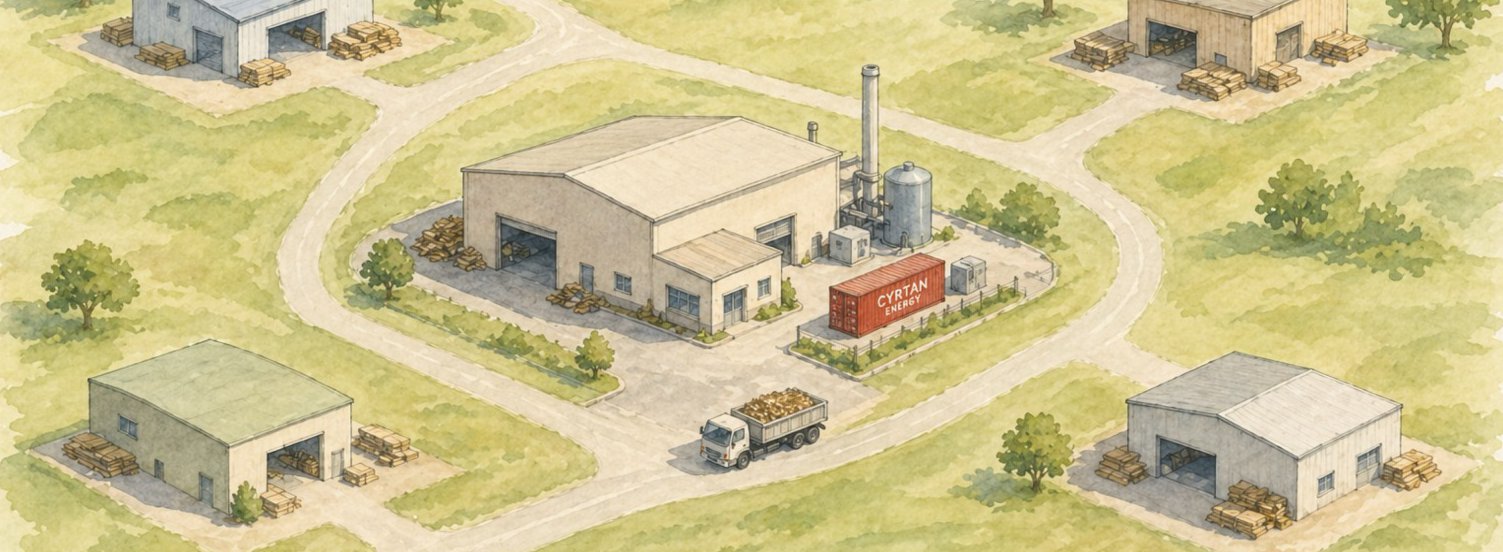
A great solution only works when it fits into the right ecosystem.
The Brief
Clean wood already has a working disposal market. Contaminated wood, painted, pressure-treated, glued, or composite, does not. Recyclers reject it, it is too dense and combustible for municipal waste processing, and its only exit today is the landfill. No competitor operates in this space.
Why Manufacturers Are Stuck
Material
Wood waste splits into a clean stream recyclers accept and a contaminated stream they reject. Whole loads get reclassified as trash when contamination is detected, and preservatives like arsenic, chromium, and copper make standard recycling unviable.
Financial
Tipping fees reached $62.28 per tonne nationally in 2024, plus $2–$10 per mile in hauling. With fuel surcharges and vendor margins, regional manufacturers face $300–$400 per tonne, too little volume each to justify on-site processing.
Operational
Sorting streams, scheduling hauler pickups, keeping on-site storage within regulatory limits, and maintaining compliance paperwork falls on plant managers and yard supervisors who are also running production.
Field Research in Millersburg, Ohio
- Even small shops generate a lot of treated waste: one furniture finisher disposes of four 55-gallon drums every three to four weeks, roughly $40,000 a year.
- Many burn combustibles in basic on-site incinerators that capture no energy, and the residue still needs professional removal from distant vendors.
- Manufacturers’ main concern was operational independence: specialized disposal sits in distant industrial hubs, leaving them at the mercy of third-party schedules and fuel surcharges.
- The most significant finding was geographic density. These manufacturers are not isolated; within a small radius there are dozens of shops facing the same $40,000-a-year problem.
Instead of trying to sell a plant to a single manufacturer, Cyrtan starts a pilot positioned as the heart of a 30-manufacturer cluster. Aggregating waste from nearby shops creates a consistent, high-volume feedstock that justifies a local energy hub: a community-utility model, not a single-customer sale.
How the Recovery Hub Works
Discovery & contracting
Identify manufacturer clusters, estimate waste volumes through site assessments, and sign annual flat-rate capacity contracts.
Preprocessing
Frequent small-load, just-in-time deliveries to the hub. Material is weighed, tracked by source, sorted, and pelletized into generator-ready feedstock.
Value creation
Cyrtan’s containerized generator converts the feedstock to electricity, stored in Cyrtan batteries and sold to local grids, community energy buyers, or the manufacturers themselves.
A Win-Win Value Exchange
Cheaper, simpler, predictable disposal
Priced below today’s $300–$400 per tonne burden, one contract instead of multiple haulers, fixed annual pricing instead of volatile fees, documentation that supports compliance and sustainability reporting, and control over disposal timing.
Low-cost feedstock and recurring revenue
A continuous, concentrated biomass supply that customers pay to remove, two revenue streams (disposal fees and energy), first-mover advantage with no direct competitor, and a template that scales by replicating clusters across the Midwest.
The Financial Model
The Project Video
What I Took Away
- The best insights often come from unexpected conversations.
- Every meaningful innovation begins with ambiguity.
- Curiosity matters more than having all the answers.
- A strong team can navigate unfamiliar territory.