Duolingo Case Study.
Keeping goal-driven learners past week one, by giving them control over what and how fast they learn.
How might we design or reimagine a Duolingo feature that improves a key metric like retention, engagement, or learning progress, through user-centered design?
Where Duolingo Stands
Users are growing fast. The share who pay is not.
Monthly users grew 32% year over year, while subscriber penetration (subscribers as a share of monthly users) stayed nearly flat at roughly 8%, which points to limited premium conversion. Source: Duolingo shareholder letter, Q4 / FY 2024.
The Goal: Grow Subscribers
Monthly user
Duolingo already wins here. Expanding the user base is going strongly.
Engaged daily user
Turning a monthly user into an engaged daily one is something product changes can move directly.
Subscriber
Daily-to-paid conversion depends mostly on pricing, marketing, and premium benefits, which product changes influence less.
This is the critical mid-term window where most potential subscribers are lost. Users still active after Day 7 are high-intent learners, but many churn before Day 30 because their needs aren’t met. Keeping them engaged longer grows the pool that can convert to paid.
Two Learners, Two Journeys
Lin, 21, student at Stanford
Learning Korean for fun, driven by K-pop. Practices 5 to 7 times a week for 5 to 10 minutes on the bus. Enjoys streaks and XP, focuses on basic phrases over grammar, and is unlikely to go premium. Pain points: hearts and energy limits feel punitive, repetition causes burnout, and streak guilt pressures her to protect the streak over real learning.
Jia, 35, consultant in India
Learning German because she moves to Germany for work in four months. Practices 3 to 5 evenings a week for 15 to 20 minutes, wants fluency through focused practice and error correction, and is likely to pay for in-depth learning. Pain points: the course doesn’t match her goal of business conversation, the path is too rigid to control difficulty or pace, and repetition and gamification blunt her sense of progress.
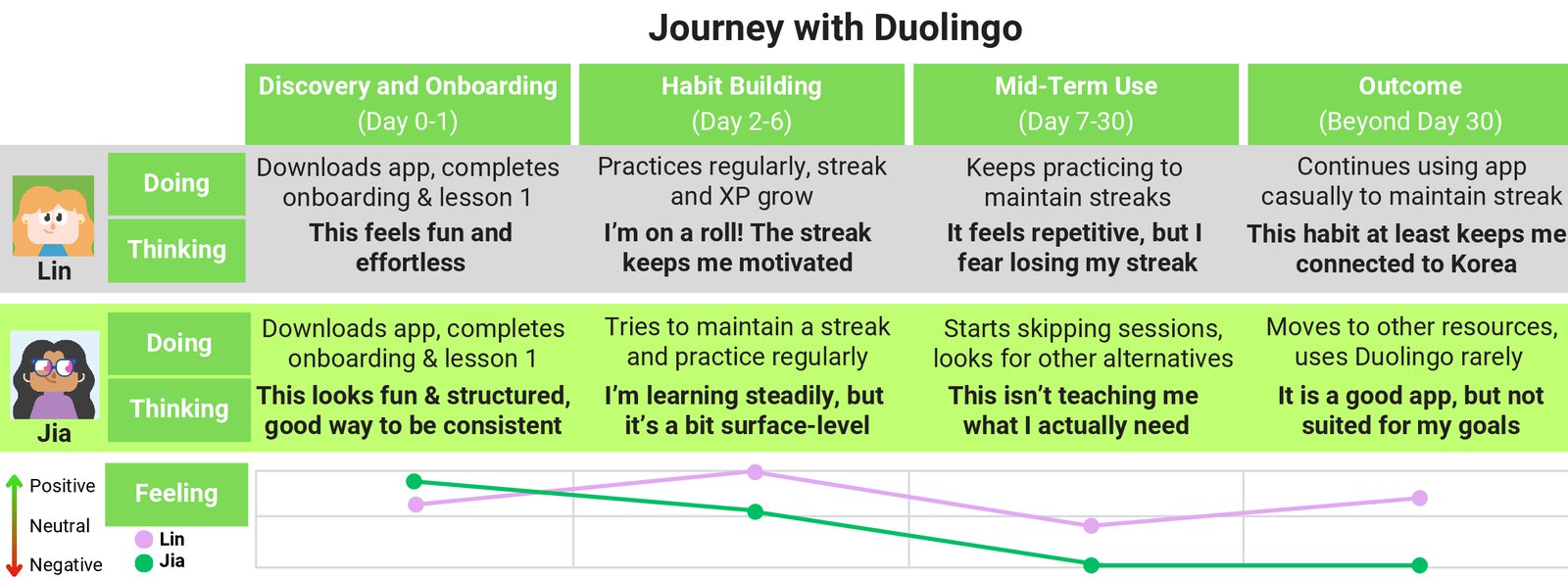
Jia’s pain points are severe enough to cause churn, goal-oriented learners like her are the ones most likely to pay for premium, and fixing her experience has the highest impact on both engagement and conversion. Hobbyists like Lin have milder pain points, and streaks and gamification already keep them around.
What Jia Needs That Duolingo Lacks
Goal mismatch
Jia wants conversational German for client meetings, business phrases first. Duolingo starts every learner on letters, sounds, and basic words, with no focused path for a specific goal.
Rigid progression
After one week she doesn’t feel challenged and wants to raise the difficulty. Questions feel repetitive, and there is no way to customize intensity, so progress feels stalled.
Progress stagnancy
She wants measurable milestones that reflect real language mastery. Duolingo tracks XP and streaks, not progress toward proficiency.
Three Solutions: Giving Learners Autonomy
Tracking and adjusting course goals
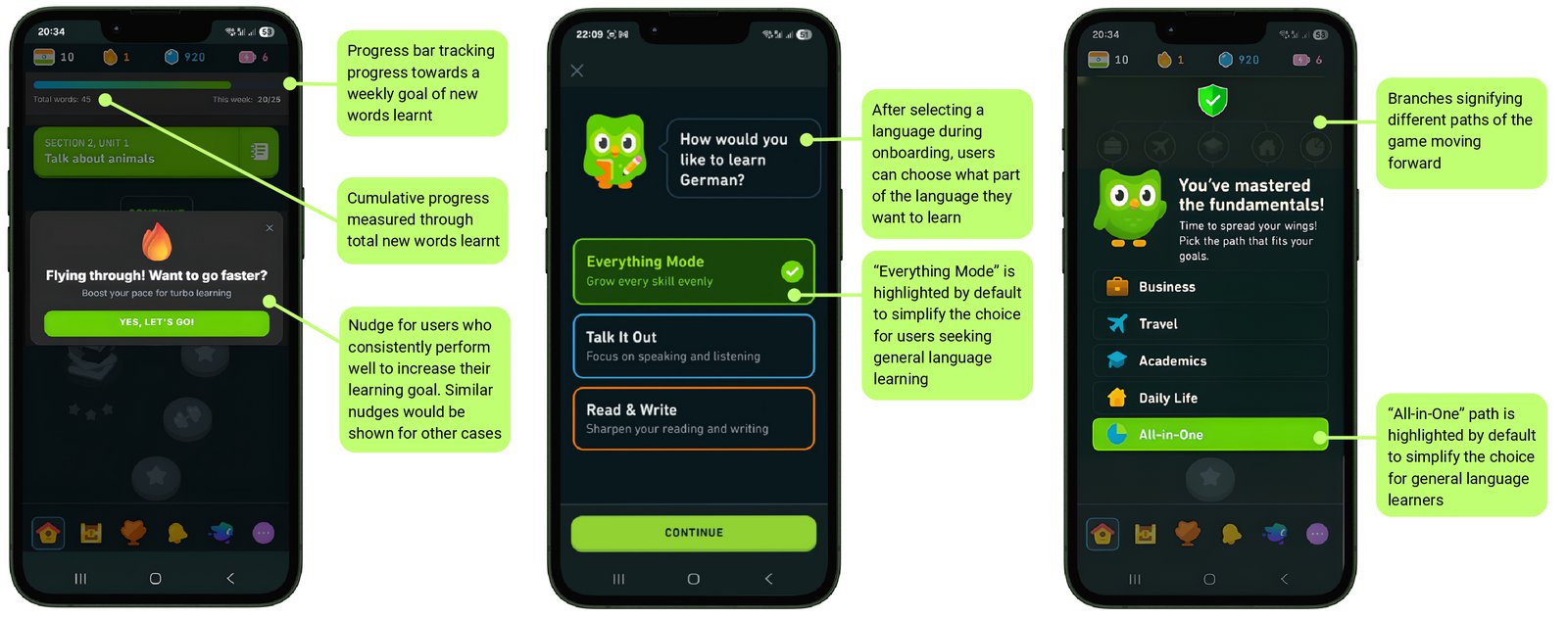
A weekly progress tracker shows cumulative progress and progress toward this week’s goal. Behavior-based nudges suggest a lower intensity when targets are missed, a higher one when lessons are flawless, and a choice either way when engagement drops. A 5-level intensity slider in the profile (default level 3) adjusts question difficulty and weekly goals.
Branching learning paths
After a week of fundamentals, learners pick a focused path: Business, Academics, Travel, Daily Life, or All-in-One. Each path runs from basics to advanced; learners can go as deep as they like and switch anytime, resuming where they left off. Level 5 in All-in-One counts as Level 5 in every path.
Course type selection
Right after choosing a language, learners pick a focus: Talk It Out (speaking and listening), Read & Write, or Everything Mode (balanced, selected by default). It can be changed later from the profile, the same way learners switch languages.
Prioritization
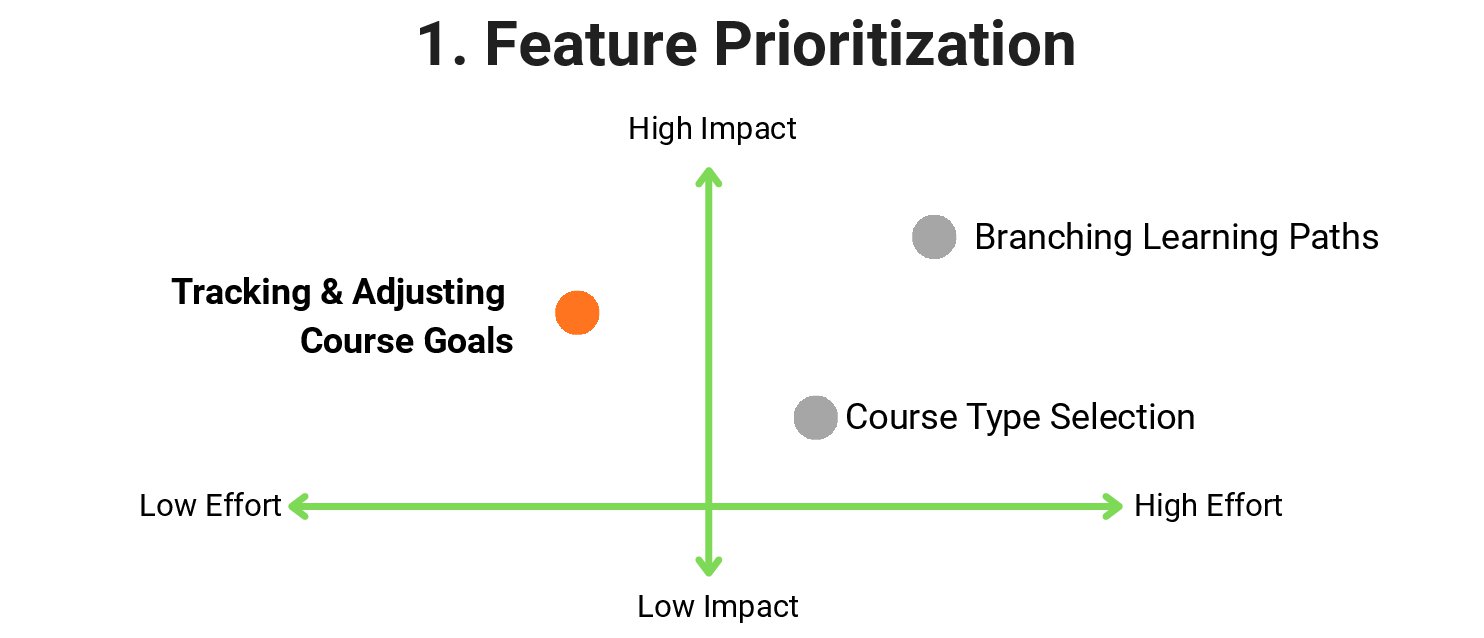
- Priority 1, tracking and adjusting course goals: low effort (simple UI, rules-based nudges triggered from telemetry) and high impact, since it drives continuous engagement and adapts intensity before progress stalls.
- Priority 2, branching learning paths: the highest long-term impact through personalization and control, but high effort, with a front-end and back-end revamp and new content for each path.
- Priority 3, course type selection: moderate effort (new onboarding flow, content tagging), but it is seen once during onboarding, so it does less for mid-term retention.
Frequent nudges can feel intrusive and annoying. So nudges trigger only after consistent behavior is observed, and their language stays supportive, not corrective.
Validating Before Building
- Academic research: users who monitor their progress are about 40% more likely to achieve their goals.
- Benchmarking: at Headspace, goal-based reminders and tracking boosted session completions by 32%.
- Duolingo user study: surveys, interviews, and contextual research with a low-fidelity prototype to confirm the value with real learners.
A/B Test Plan
Cohort A: Control
No goal tracker and no goal-adjusting nudges.
Cohort B
The goal tracker only, without nudges.
Cohort C
Both the goal tracker and goal-adjusting nudges.
What Gets Measured
- Primary: Day 7 to 30 retention (up) and nudge acceptance rate (up).
- Secondary: premium conversion rate (up), DAU/MAU (up), and churn rate (down).